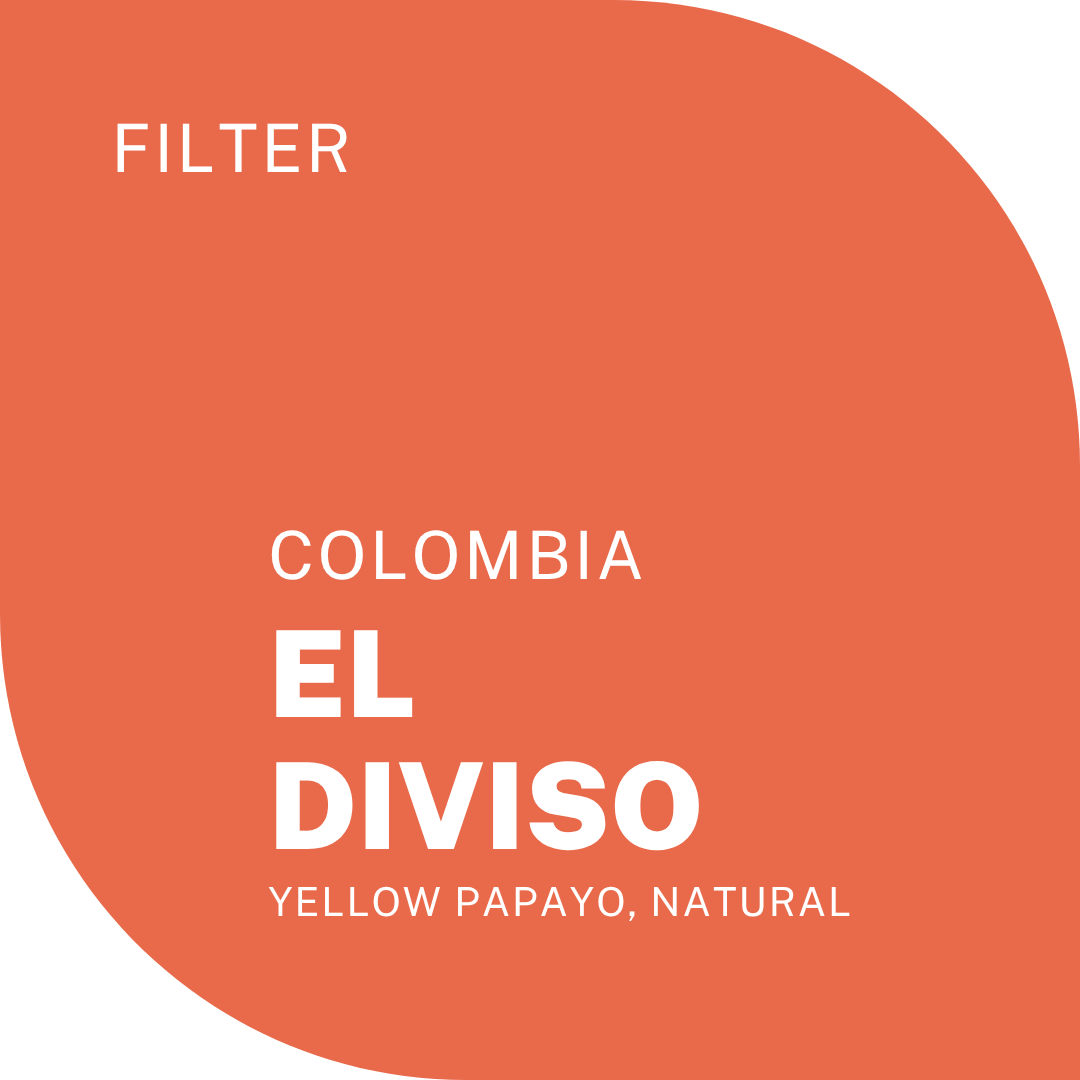
El Diviso
- Huila - Pitalito, El Diviso, Colombia
- Advance Natural
- papaya, passion fruit, sweet cherry
- 1750 meters
In the cup, the coffee reveals an expressive aroma of papaya, passion fruit, and sweet cherry, presented with remarkable clarity and intensity. The profile is juicy and vibrant, driven by a bright yet elegant fruit acidity and a pronounced, confectionery-like sweetness. The mouthfeel is silky with a medium-full body, leading into a long, sweet, tropical-fruited finish.
*The price includes VAT. All our coffees are whole beans. Grinding per request.
Specifications
Flavor profile
papaya, passion fruit, sweet cherry
Aroma
- Chocolate
- Floral
- Fruity
- Funky
- Spicy
Roast profile
- Light
- Medium
- Dark
Optimal quality
Days 14–75 after roasting
Store coffee in a dry and cool place. For optimal quality, consume within 7 days of opening the bag.
Make coffee at home
Coffee: 18 g
Water: 270 ml at 95°C
Water TDS: 50 mg/l
Grinding: 650 μm (sea salt size)
Blooming: 30 seconds
Extraction time: 2 minutes 30 seconds
5-STEP PREPARATION
1. Prepare the filter: Place a paper filter in a V60 dripper and rinse it thoroughly with hot water. This removes any paper taste and warms the container at the same time. Discard the excess water.
2. Add coffee: Pour 18 g of medium ground coffee (sea salt size) into the rinsed filter. Make sure the coffee bed is evenly spread.
3. Blooming – first pour: Start pouring with 50 ml of hot water. Pour slowly, starting in the middle and working your way towards the edge. Wait 30 seconds for the coffee to degas (bloom).
4. Main pour – second pour: At a total time of 30 seconds, slowly add 110 ml of water. Pour in a circular motion, starting in the middle, gradually moving towards the edge and back towards the center. Make sure to evenly moisten the entire coffee bed.
5. Final pour – third pour: At a total time of 90 seconds, add the remaining 110 ml of water. Use the same pouring pattern – starting in the middle and gradually moving the stream towards the edge and back towards the center.
The entire pouring process should be completed in approximately 2 minutes 30 seconds.
TIP
To find the perfect cup for your taste, you can experiment with different variables at home. Do this with only one variable at a time to help you understand how it affects the taste. Record the results to help you find the perfect recipe for your coffee faster.
GRIND SIZE
– A fine grind (smaller particles) will increase extraction time and increase flavor intensity.
– A coarse grind (larger particles) will decrease extraction time and create a lighter, more delicate flavor.
COFFEE : WATER RATIO
– More coffee to the same amount of water will increase flavor intensity.
– Less coffee to the same amount of water will give a more delicate, balanced flavor.
WATER TEMPERATURE
– A higher temperature (94–96°C) will emphasize the sweetness and body of the coffee.
– A lower temperature (90–92°C) will reduce bitterness and give a brighter, more acidic profile.
BLOOMING TIME
– A longer blooming (30–45 seconds) can improve extraction uniformity and highlight complex flavors.
TOTAL EXTRACTION TIME
– Shortening the time (e.g. 2:00 min) will produce a lighter and more juicy coffee.
– Increasing the time (e.g. 3:00 min) will produce a stronger and richer cup.
Coffee: 18g
Water: 270ml at 95°C
Water TDS: 50mg/l
Grind: 700μm
Blooming: 30 seconds
Extraction time: 2 minutes 45 seconds
Preparation process:
1. Filter rinsing: Place paper filter in Chemex and rinse thoroughly with hot water (to remove paper taste and preheat the container). Discard rinse water.
2. Coffee preparation: Pour 18g of coffee (table salt size) into the filter and level the coffee bed.
3. Blooming: Pour 70g of water evenly over the surface of the coffee. This topping should last 15-20 seconds, then leave the coffee to bloom for up to 40 seconds total.
4. Main pour: At 40 seconds, add the remaining 200 grams of water in two parts:
First part 100 grams of water in a circular motion over 15 seconds of pouring. Wait until the water has almost completely drained.
Second part: Add the last 100 grams of water at the same rhythm. The entire pouring process should be completed in about 2 minutes.
5. End of extraction: The total extraction time should not exceed 3 minutes. After the water has drained, the coffee bed should be smooth and level – this is a sign of even extraction.
Tips:
• Pour in concentric circles from the center outwards.
• Make sure that no ground coffee remains on the edge of the filter.
• Water TDS: Aim for a water TDS of around 1.40.
• Calibration: If the extraction time is too long, use a slightly coarse grind, if too short, try a fine grind.
Coffee: 100 g
Water: 1000 g
Water temperature: 8-12 °C
Extraction time: 6-8 hours
TDS of water: 90 mg/l
A story about coffee
The story of the El Diviso and Nestor Lasso estate
Five years ago, brothers Nestor and Adrian Lasso took over the family farm and decided to completely change course – instead of traditional coffee production, they dedicated themselves to experimentation and the specialty segment. Together with Jhoan Vergara (also the son of a coffee farmer), they founded El Diviso – a project that brings together two estates: El Diviso (Lasso) and Las Flores (Vergara), near Pitalito in the Huila region of Colombia. Their collaboration deepened further with the inclusion of CATA Export, run by Cat and Pierre.
Together, they embarked on a journey of research into fermentation techniques to develop processing protocols with a clear goal: to connect these coffees directly to the European market. The process was long and financially demanding, but today these coffees are present in barista competitions across Europe – among other things, they won the Brewers Cup in Ireland and took 3rd place in Austria.
Nestor’s words “I grew up in Normandy near Pitalito, where coffee is part of everyday life. My memories are full of playing in nature and a happy childhood. Being a coffee farmer in Colombia is not easy – income is low, survival is only possible through self-sufficiency. That’s why many young people leave the countryside. But I was always driven by passion. When I realized that specialty coffee offered a possibility of development – both economically and educationally – I gave myself completely to this world. Together with my brother, I studied at SENA, the most renowned agricultural school in Latin America, where we acquired theoretical knowledge about agronomy and fermentation. But real experience comes with practice. Today, I am thrilled that more and more Colombians are drinking their own roasted specialty coffee. This means that the local coffee drinking culture is also changing.”
Fermentation process
This coffee undergoes an advanced natural process for the Yellow Papayo variety, designed around multi-stage fermentation and precise drying control. The cherries were harvested at very high ripeness (24–28 °Brix), followed by water flotation for selection and a sequence of fermentation stages: 36 hours of oxidation in cherry, 24 hours of anaerobic fermentation in bags or containers at 16–18 °C, an additional 24 hours of oxidation in cherry, and then 48 hours of submerged fermentation with recirculation of fermentation leachate. After fermentation, a thermal shock at 50 °C for 30 minutes was applied, followed by a special technique in which the coffee was first dried to 18–20% moisture, then rehydrated, and fresh cherries were mixed with rehydrated cherries in a 50/50 ratio before depulping. Drying took place in a mechanical dryer with a dehumidifier, first for 60 hours, then the coffee was stored at 18% moisture in black bags without light for 60 hours, after which drying resumed until reaching a final moisture content of 11%.